Editorial
Ape Out's Jazz Violence — How Every Hit Becomes a Drumbeat
When I pushed the guard down for the first time in the maze of Ape Out and watched his body smash the glass, the saxophone made a harsh hiss, and the…
The first shove that sounded like a cymbal
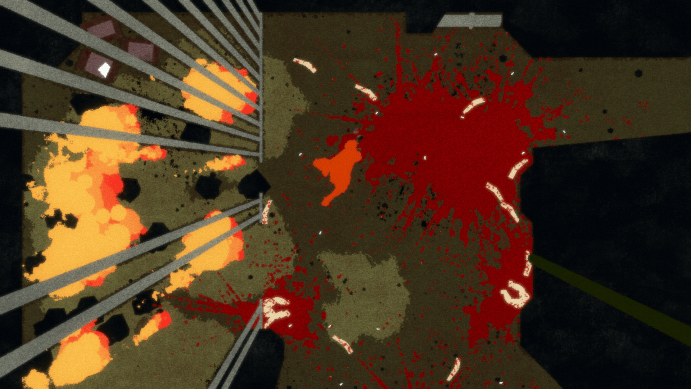
When I pushed the guard down for the first time in the maze of Ape Out and watched his body smash the glass, the saxophone made a harsh hiss, and the cymbal of the drum immediately exploded.
I was not playing a prison break game, but directing an improvisation of violence and freedom.
Gabe Cuzzillo and his team have created an unusual game: turning every kill into a note on the score.
On the office floor of the third level, the gorilla I controlled was rampant in the compartment maze.
Every time a guard is blown away, the drum beat increases by one point; every time a glass wall is smashed, the trumpet plays a passionate solo, when I was surrounded in the open office area, the music suddenly turned into chaotic free jazz, and all kinds of instruments seemed to be playing in different tunes; and when I found the escape channel, all the instruments returned to the harmonious rhythm in an instant.
Music that follows your mess, not a script
This is not the preset background music, but the soundscape generated by my actions in real time.
The wildest moment happened in the archive chapter.
There are no guards here, only rows of infinitely extended file cabinets.
When I began to push down the first row of cabinets, the double bass pulled out a long note; when I pushed down the second row, the piano added a simple arpeggio; by the time I pushed down the tenth row, the whole jazz band had entered a full-speed improvisation state.
But when I stopped to think about the route, the music was still at once, leaving only the heavy breathing of the gorilla.
The archive level changed how I played
This absolute sound and picture synchronization made me feel like: it seems that I am not playing the game, but the game is “playing” the music I create.
As the level progressed, I began to consciously “compose music”.
In the corridor, I will deliberately slow down the rhythm to keep the drum beat stable; in the open hall, I will trigger the explosion of brass instruments with a rapid charge.
Once, for the experiment, I tried to pass through an area with the least amount of action, and the result was a minimalist cold jazz, with a lazy piano sound and sparse drum beats, which was not like a prison break story at all, but like a live performance in a late-night bar.
On the weekend after finishing the game, I searched for other players’ clearing videos on YouTube.
Composing by accident
In the same level, the video of radical gameplay is matched with grumpy hard pop, and the video of stealth gameplay is the tune of cool jazz.
The clearest design choice of this game is manifested here: it does not rate players and does not set up standard solutions, but gives the power to create music completely to the players themselves.
Your violent aesthetics determines your jazz style.
Now when I hear the real jazz performance again, I always unconsciously imagine that if the pixel gorilla is on the stage, what kind of action should be used to match this solo.
Ape Out has changed my understanding of the sound of the game , the most moving melody does not necessarily come from the composer, but also from the most instinctive operating rhythm of the player.
After credits
If you also want to be a jazz violent conductor, Ape Out will give you the most primitive freedom of expression.
Here, every collision is improvised, every escape is a solo, and the whole game is your instrument.
When you finally break through the last iron gate and the moment when the sun pours down, you will find that the sound of freedom is so deafening.
Keep exploring
Explore on Vivid-seed Games
Ready to play? Browse free HTML5 games or read more guides.
Articles on Vivid-seed Games are written by our editorial team for entertainment and general education. They are independent editorial content and are not required to link to a specific game on this site. Illustrations are sourced from licensed stock libraries (e.g. Unsplash, Pexels) as credited in captions.
More to read

The big challenge of skiing feels like a winter postcard with teeth

Golf Garden: A Calm Browser Session Worth Revisiting on Vivid-seed Games

food lover Big battle turns kitchen chaos into a short browser break