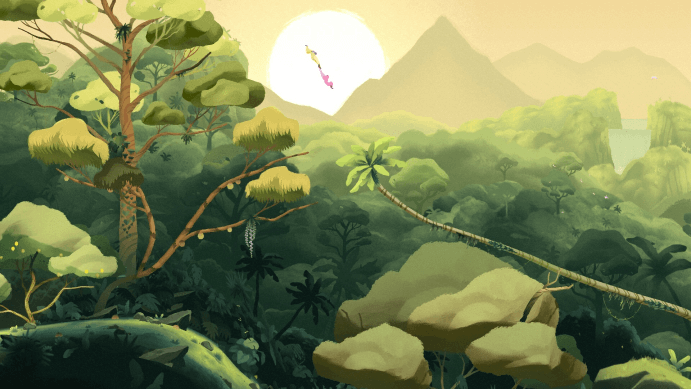
When I set foot on the pearly beach of Paradise Island, the sea water was solidified, and the waves hung in the air like glass sculptures. The sky is eternal twilight, and orange and purple are painted together like undried oil paints. There is no alternation of day and night, no seasonal flow, only a stillness named “perfect”. And I, an investigator known as the “Detective of Love”, was summoned to crack a crime that should not have existed in this utopia: murder. _Paradise Killer_ throws me into a hedonistic ruin where time has been deliberately suspended, and tells me that the truth may not exist, but the trial must be carried out — even if it is just to break this suffocating eternity.
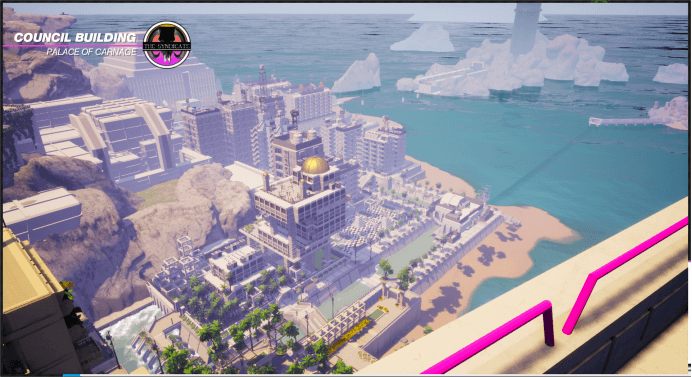
Paradise Island is the 24th utopia experimental field built in the reincarnation of civilizations, a divine race known as “exiles”. After running for a period of time, each island will be destroyed together with all residents once it is judged to be “perfect”, and the gods will carry their memories into the next creation. But this time, on the eve of the upcoming restart, a key member was killed. The restart was “definitely postponed”, and I had to investigate in the gap of time. The contradiction here tore apart the perfect appearance from the beginning: a society that pursues extreme pleasure and aesthetics, but its existence itself is based on the logic of periodic collective extinction. My investigation has become an anatomy of the system itself.
The game gives me unprecedented freedom to investigate. The whole island is an open world, and I can visit any place at any time and in any order: a temple made of gold, a nightclub full of neon lights, a manor with glowing plants, or a secret prison hidden in the mountain. There is no task mark to force my route, and the clues are scattered in every corner of the environment in fragmented form — a holographic recording, a slate engraved with secret language, a forgotten diary, or unintentionally revealed details in a character’s dialogue. I need to connect them with my own logic, and the game never judges whether my inferences are right or wrong. It is only responsible for faithfully recording all the “evidence” and “inferences” I have collected on a huge wall of thinking, and let them grow or even contradict each other.
The most fascinating is the residents here — the descendants of the gods who call themselves “exiles”. They are gorgeously dressed, exaggerated in their words and deeds, immersed in eternal parties, artistic creation and philosophical debates, but they show a disturbing sense of alienation from the imminent “restart” and murder. Everyone seems to have a secret, everyone has a motive, but everyone lives in a state of almost performance. Talking with them is like participating in an improvised play. I need to choose the angle of asking questions, whether to cater to their vanity or expose their disguise? Do you believe the testimony they provide, or look for flaws in their twinkling eyes and the hidden secret room in the palace? Here, socializing itself is the most core part of detective work.
As the investigation deepened, I found that the murder case was much more complicated than it appeared. It involves the power struggle of the island, different interpretations of the definition of “perfection”, private feuds spanning multiple reincarnations, and a secret resistance movement that tries to resist the “restart” fate. The clue points to multiple possible murderers, and each inference can be so logical. There is no only “true ending” in the game, but different trial results and narrative interpretations are given according to the combination of evidence and the object of accusation that I finally submitted to the court. The “truth” I chose is actually the “interpretation” I made to this stagnant world based on the fragments in my hand that is most in line with my personal judgment.
When I finally stood in the court made of crystal and gold, facing the “suspects” I had talked to, feasting and even flirting with, and reading my accusations, what I felt was not the pleasure of a detective revealing the mystery, but a heavy power. The “truth” I have will determine whose eternity will end and whose story will be written in the next round of reincarnation — or whether there will be a next round of reincarnation. In this place where time is no longer flowing, my choice has become the only force that can push history.
After clearing the customs, the sweet perfume smell and the illusory sunset shadow of Paradise Island seemed to be still stuck to the senses. _Paradise Killer_ didn’t give me a clean answer. It gave me a gorgeous reflection on the price of truth, justice and perfection. It allowed me to spend the most time-consuming detective journey in a place where I didn’t have time. In the end, I understand that sometimes the purpose of the investigation is not to reach a certain end, but to bravely draw the uncertain but “moment” mark in the eternal suspension. Because it is these marks that let us touch the evidence of our real existence in the perfect nothingness.