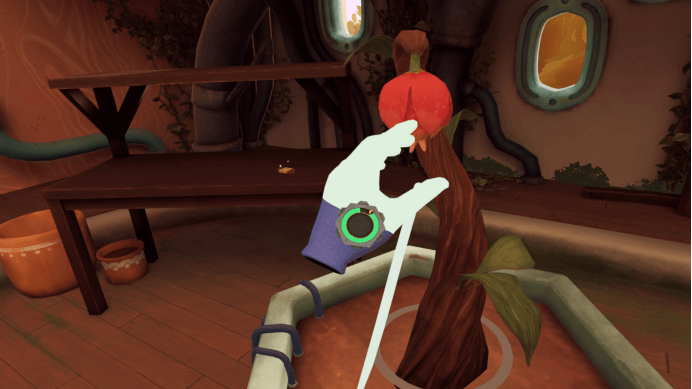
When I first started the buzzing vacuum gloves and peeled off a pulsating, asphalt-like black mucus from the surface of the rock, there was a faint heartbeat in the mucus. Then, strange crystal lines emerged on the rock wall that had just been cleaned up, like polished memories, and suddenly began to breathe. My partner Rani and I drove the dilapidated “Garbage” spacecraft to this planet. I thought it was just another ordinary waste recycling operation, but I didn’t know that what we were doing was a careful neurosurgical operation on the forgotten planet.
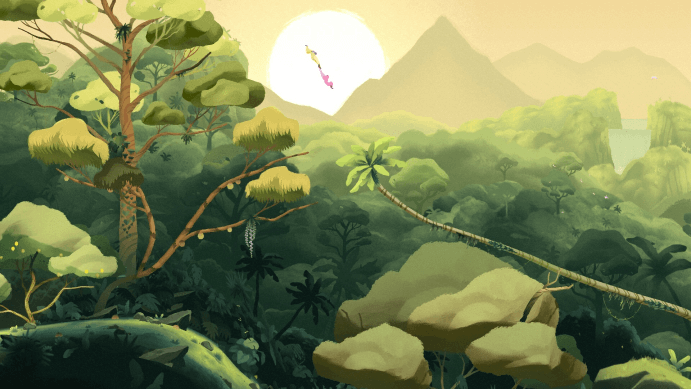
The planet is dead silent, and the surface is covered with mucus that we call Gunk. It swallows light and absorbs sound, making the whole world like a wet black blanket. Our task is simple and straightforward: absorb mucus with the modified gloves in the left hand, analyze the planet data with the scanner in the right hand, and find valuable resources. But soon, something strange appeared. Every time an area is cleaned up, the planet will “wake up” a little — the plants wrapped in mucus will shake off the darkness and show luminous branches and leaves; the buried ancient machinery will restart, projecting a vague holographic image. The planet seems to be using our hands to remove its rotten and self-enclosed “skin” layer by layer.
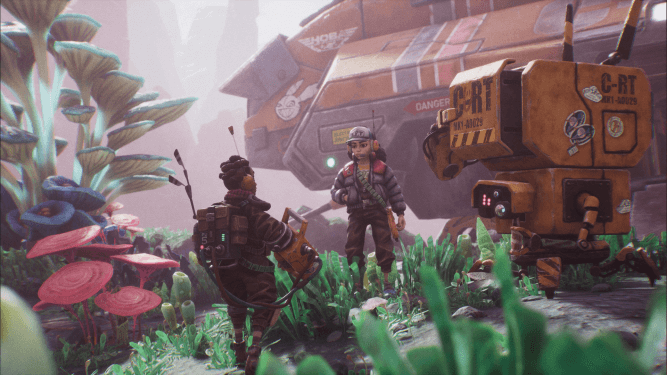
The most shocking thing is not the visual change, but the return of sound. Under the cover of mucus, the world is silent. With the cleaning, the sound of wind, the sound of water, the sound of insects flapping their wings, and those unrecognizable frequencies, as if the rocks were whispering, gradually intertwined into a complex planetary symphony. Rani kept uploading analysis reports from the orbit, pointing out the abnormal recovery of the planet’s ecology and the synchronous changes of the geological structure. Her voice gradually changed from the calmness of business to the excitement and faint uneasiness of scientists. We realize that Gunk may not be an alien parasite, but more like a “traumatic tissue” of the planet itself, a biological scab generated to seal up a great pain or secret.
As the exploration deepens, we find the traces of this civilization — not magnificent buildings, but exquisite irrigation systems, community-scale settlement traces, and a technical path that focuses on resonance with nature. This civilization does not seem to be destroyed by war or disaster, but actively chooses some form of “dormancy” or “encapsulation”, and Gunk is their cocoon. My cleaning work brings a sense of solemnity that is almost offensive: am I helping to break the cocoon, or is I destroying the final ritual of civilization’s self-protection?
The core action of the game “absorption” has also become emotionally complicated. At first, the feedback that sucked the mucus into the glove was very satisfying. But as the story progresses, every time I absorb a ball of Gunk, I seem to feel the slight trembling of the planet. Especially when approaching the core of the planet, a luminous structure similar to a neural network begins to emerge in Gunk, and absorbing them is more like cutting off some organic connection that is still in operation. Rani’s warning in the newsletter is also becoming more and more serious: our intervention may be triggering an irreversible planetary chain reaction.
In the end, in the deepest part of the planet, what we are facing is not monsters or treasures, but a huge, quiet, heart-like core. It is composed of light and crystals, and is protected by the last and thickest Gunk. Rani’s data shows that activating it may completely wake up the planet, or it may cause the system to collapse and everything to zero. Our partners, who had been quarreling and losing each other, but extremely trusted, fell into silence at that moment. The right to choose is in the hands of me, a worker holding a “cleaner”.
I chose to activate. The light of the core blooms gently, like a deep breath. Gunk did not completely disappear, but retired and turned into a fertile soil to nourish the newborn. The whole planet is reconstructed in the light, and the relics and new plants coexist in harmony. The silent wisdom of a civilization finally sees the light of day again. Instead of “returning”, it entrusted its legacy to the new life of the planet itself.
Back to the “junk number”, Rani looked at the lively planet atlas on the scanner, and it was rare not to make fun of it. She said, “We used to think that we were picking up garbage in the universe, but now it seems that we have... become a midwife.” The spaceship sailed away, and the once silent planet rotated quietly outside the porthole, like a polished gem.
_The Gunk_ has no thrilling battles or complicated puzzles. It tells a story about healing, respect and a second chance with the simplest “cleanup” action. It makes me feel that perhaps the greatest adventure in the universe is not to conquer the unknown, but when you happen to meet the scars of a silent world, you choose to lend a hand and be willing to listen to the first faint heartbeat after it wakes up.