I raised my hand for the first time and drew an arc in the air surrounded by gears and brass — picking a glowing fruit and gently putting it into the transport basket. Then, I pressed the “Record” button and took a step back. A “I” outlined by light appeared, and it accurately repeated my action just now, over and over again. Soon, the second and third light and shadow joined, and they relayed, and a mechanical assembly line of picking, transmitting and returning to its position ran silently in the silent greenhouse. At that moment, I was not solving puzzles, but writing a requiem composed of infinitely looped actions for a dead garden.
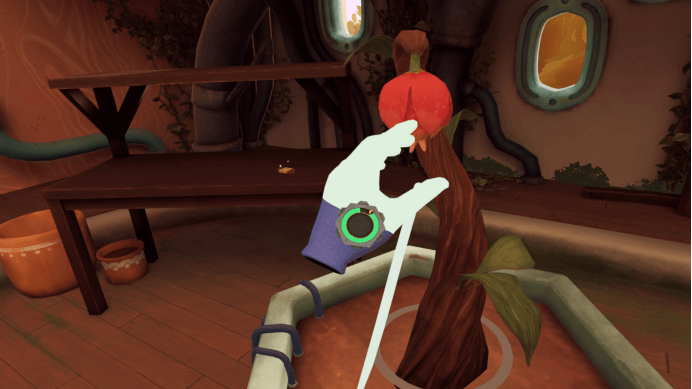
_The Last Clockwinder_ put me in the depths of a clock tower greenhouse hanging high in the clouds. It used to be an ecological miracle maintained by automatic machinery, but now there are only paralyzed organs and dying plants. My task is not to repair complex gears, but to become the gears themselves — inject the most primitive and humane “programs” into these ancient machines with the movements of my body. The core mechanism of the game “action recording” is surprisingly simple: I perform an action with my own hands, record it, and then create a “phantom worker” who will repeat this action forever. The key to solving puzzles is never an external tool, but my own physical memory and time and space planning.
At first, I just built a simple assembly line for the phantoms to work together to deliver seeds or water. But as the greenhouse opened layer by layer, the challenge became an elegant arrangement. I need to arrange four phantoms to stagger and shuttle like ballet dancers, just taking the kettle in the hands of their companions, without disturbing the rhythm of the fruit transmission on the other line. Sometimes, I have to personally join this cycle and become the key living gear to make up for the time difference. My body and those light and shadow bodies together form a precise, continuous and lively living machine in the silent greenhouse. This garden no longer relies on electricity or steam. It relies on the “care” itself that is fixed, reproduced and infinitely extended.
However, behind the pride of this creation, a trace of melancholy grows quietly like a vine. Every action I recorded — every gentle picking, every precise placement — is an imitation and recollection of a disappeared gardener. Those illusions, rather than workers, are the souls who worked hard here in the past, and the remnants left by my body. I’m not creating new things. I’m using fragments of my life to fill a huge and beautiful vacancy, and let this vacancy continue to run, as if the master never left.
At the end of the game, when I walked through the eternal cycle I created and composed of countless “I” and witnessed the revitalized garden, a complex sense of alienation enveloped me. I have recovered all this, but I have to leave. And what I left behind was a whole world drawn by my own hands, but no longer needed my actions. Those lights and shadows will always repeat my posture until the clock tower is silent again.
After quitting the game, my arm seemed to have the memory of repeated swinging. What _The Last Clockwinder_ allows me to experience is not the omnipotence of the Creator, but a deep trusteeship. It reveals a moving paradox: sometimes, the best way to give a machine a soul is not to make it think, but to turn a moment of human care into its eternal pulse. And our most lasting legacy may be to engrave those actions full of love into time so carefully and accurately, until they become the light of the indelible cycle that illuminates the ruins.